Workshop
What do people eat?
Worldbuilding starts at the dinner table, not at the empire
12 July 2026
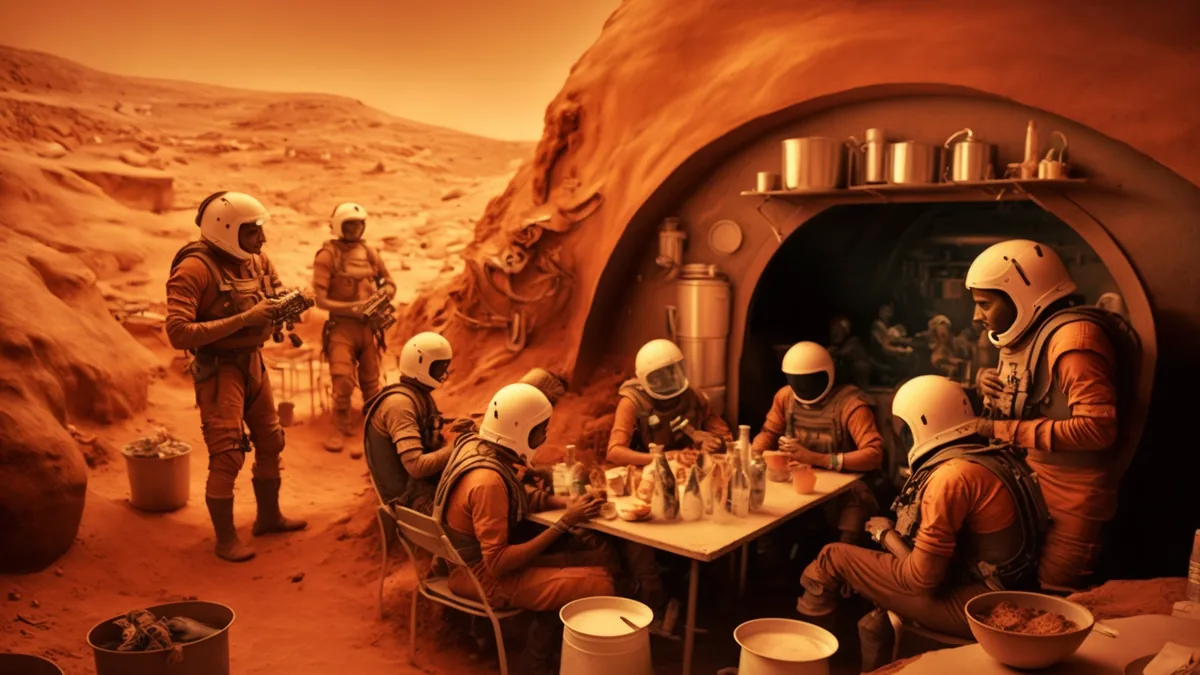
When I set up a new world, the temptation is to start at the top. At the empire. At the theory of magic. At the great map with its seven realms. It feels productive and it is usually worthless, because it does not carry a single scene.
So I start at the bottom, with a banal question: What do people eat? Everything else hangs off it. Who grows it? Who moves it? Who gets to take first? And what happens when the transport fails?
The table gives away the order
A crew eating together in front of their habitat while two armed figures stand by tells you more about their situation in one image than three paragraphs of exposition. It says: there is enough, but not so much that anyone is careless. It says: there is something out there that justifies a guard. It says: these people trust each other enough to take their helmets off.
The same principle works in a ship's mess. In Eve, the crew's growing scepticism about the mission does not arrive in a mutiny scene but in conversations that stop when an officer enters the room. The place where people eat is the place where a hierarchy becomes visible — precisely because everyone has to go there.
Magic is infrastructure too
The same holds for invented powers. Magic that can do anything tells you nothing. It only gets interesting as infrastructure: Who may learn it? Who issues the licence? What does a mistake cost?
In Chobo Year there is standardised Tahuyan magic, learned in courses and certified — and the old human witchcraft, which is intuitive, powerful and forbidden. The conflict is set before a single character wants anything: whoever makes a system safe also decides whose skill becomes worthless.
In Lorr, magic is an administered resource. The mage fortress Kjasz decides who gets trained. The Soul Dagger, which simply tears magic and soul out of a living body, is therefore not just a weapon. It is a shortcut around the entire system — and the real scandal of the book.
The rule applies to me as well
The most important part comes last, and it is uncomfortable: the rules hold even when they stand in the plot's way. Especially then.
Reika senses every kind of magic and can steer none of it. That is inconvenient. It would be so easy to grant her sudden control in chapter 19 because the scene needs it. That is the moment the world either holds or collapses. As a physicist I learned that you do not get to pick the laws after you have seen the result. In writing, that is not a shackle but the source: if the character is not allowed to take the shortcut, she has to walk the longer road — and that road is the story.