Worlds
The universes behind the stories
No worldbuilding compendium, no spoilers. Just a few things you are allowed to know before you open the first chapter.

Lorr
The world of The Soul Dagger
Lorr is a secondary world: its own history, its own peoples, its own physics of the supernatural. Two places define the balance of power — the royal city Lyandra and the mage fortress Kjasz. The king rules; the fortress decides who may cast.
Portal magic connects Lorr with Naan, a mirror world, and with Earth. Those connections are regulated, which is not the same as controlled. Non-human peoples — the Sserdou and the Grathoi — live here with interests of their own, not as a footnote to human politics.
In Lorr, magic is an administered resource. Who is permitted to learn it is a political question. That is the ground on which the fight over the Soul Dagger grows.
Armstrong
The Moon city from Chobo Year
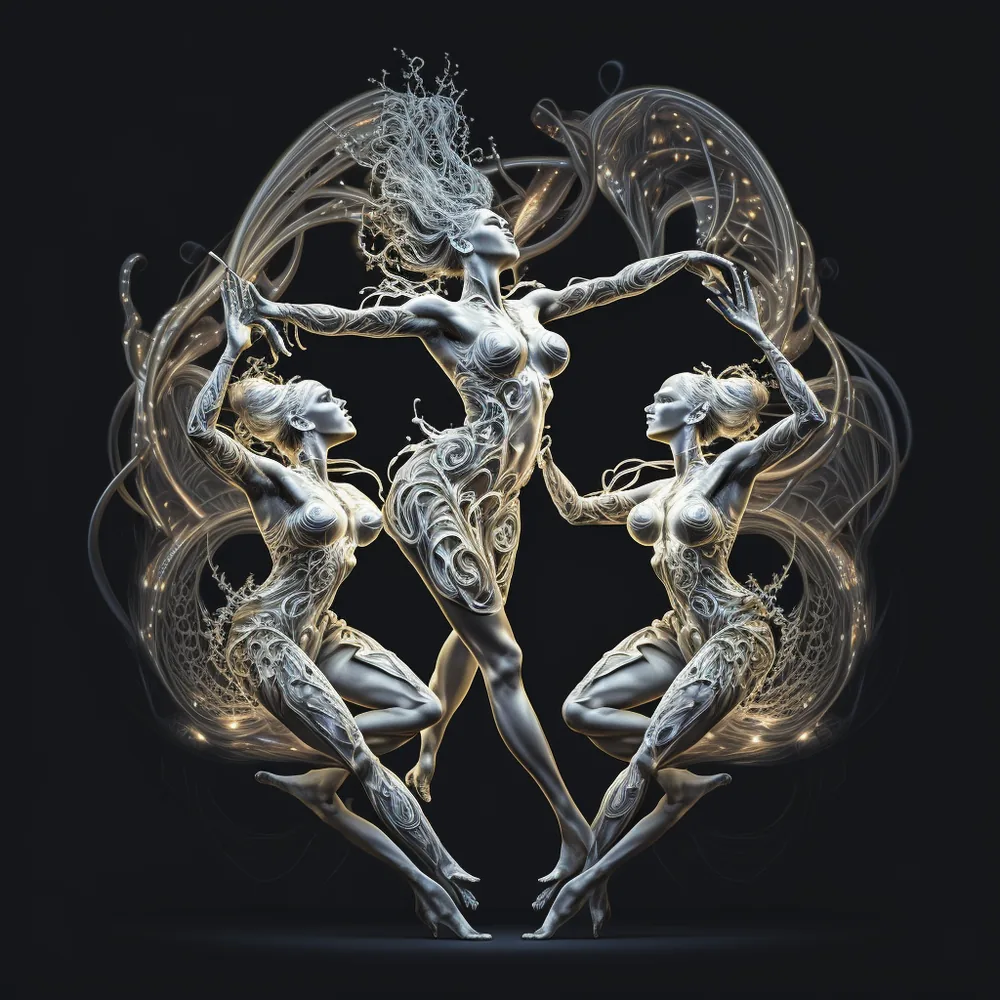
22nd century, the Moon. Armstrong lies beneath a shimmering magic dome; below the surface a labyrinth of tunnels, chambers and training halls branches out, their walls etched with protective runes so the magical energy stays in the room.
Above the city lies the Garden of Artemis: alien flora under iridescent light, trees with trunks glowing neon blue and violet, and they move — in step with the Moon's magical tides.
Humanity belongs to the trade network of the Tahuyan Empire. With the network came alien species — the scaled Tahuyans, the bioluminescent Ululucs, the shapeshifting Barparpier — and a standardised magic that declared everything human-made to be witchcraft.

The geometry in between
Kepler, 72 degrees, the pentagon
The same order shows up in both worlds: the pentagon, the 72-degree angle, the star chart as a blueprint. For Kepler, geometry was the key to the heavens — „ubi materia, ibi geometria“, where there is matter, there is geometry.
In my worlds it is the key to magic. Portals, runes and navigation schemes follow it. That is neither coincidence nor esotericism: it is the rule that makes an invented force calculable — and therefore tellable.